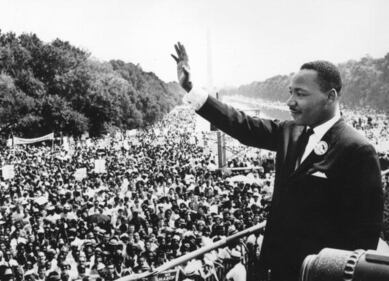
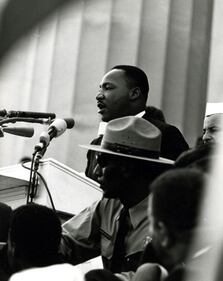
Black American civil rights leader Martin Luther King (1929 - 1968) addresses crowds during the March On Washington at the Lincoln Memorial, Washington DC, where he gave his 'I Have A Dream' speech. (Photo by Central Press/Getty Images)
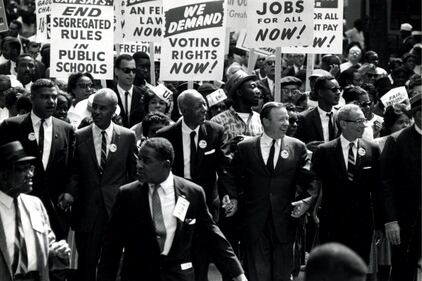
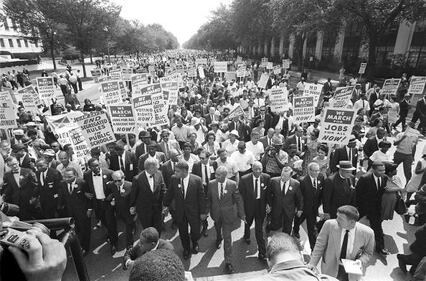
Civil Rights leaders holds hands as they march along the National Mall during the March on Washington for Jobs and Freedom, Washington DC, August 28, 1963. The march and rally provided the setting for the Reverend Martin Luther King Jr's iconic 'I Have a Dream' speech. Among those pictured are, front row from left, National Urban League executive director Whitney Young (1921 - 1971), National Association for the Advancement of Colored People leader Roy Wilkins (1901 - 1981), labor union and Civil Rights leader A Philip Randolph (1889 - 1979), labor union leader Walter Reuther (1907 - 1970), and civil rights leader Arnold Aronson (1911 - 1998). (Photo by PhotoQuest/Getty Images)
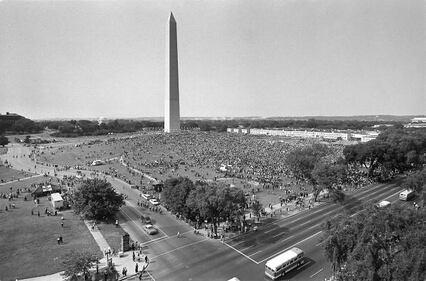
WASHINGTON, : More than 200,000 civil right supporters gather 28 August, 1963 on the Mall in Washington DC ( Washington Monument in background) during the "March on Washington", that US civil rights leader Martin Luther King,Jr. said the march was "the greatest demonstration of freedom in the history of the United States." King delivered his "I have a dream" speech during the rally, which is credited with mobilizing supporters of desegregation and prompted the 1964 Civil Rights Act. 28 August, 2003 marks the 40th anniversary of the speech. King was assassinated on 04 April 1968 in Memphis, Tennessee by James Earl Ray, who confessed to shooting King and was sentenced to 99 years in prison. AFP PHOTO/FILES (Photo credit should read AFP/AFP/Getty Images)
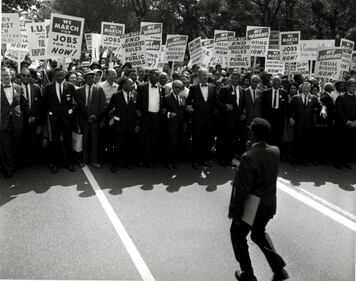
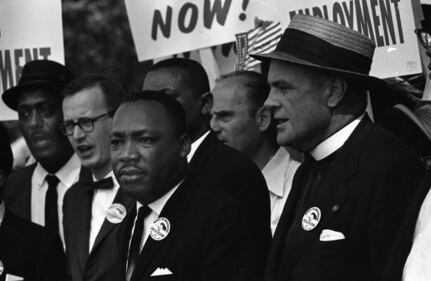
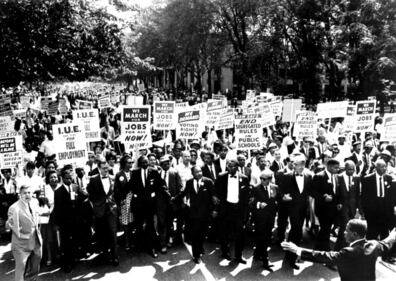
Civil Rights leaders holds hands as they march along the National Mall during the March on Washington for Jobs and Freedom, Washington DC, August 28, 1963. Among those pictured in the front row are American Civil Rights leader Dr. Martin Luther King Jr. (1929 - 1968) (5th left), Civil Rights activist Rabbi Joachim Prinz (1902 - 1988) (7th left), National Urban League executive director Whitney Young (1921 - 1971) (9th left), National Association for the Advancement of Colored People leader Roy Wilkins (1901 - 1981) (10th left), labor union and Civil Rights leader A Philip Randolph (1889 - 1979) (11th left), labor union leader Walter Reuther (1907 - 1970) (12th left), and civil rights leader Arnold Aronson (1911 - 1998) (13th left, though he is facing away from the camera). The march and rally provided the setting for Dr. King's iconic 'I Have a Dream' speech. (Photo by PhotoQuest/Getty Images)
(FILES) US civil rights leader Martin Luther KIng (3rd from L) walks with supporters during the "March on Washington" 28 August, 1963 after which, King delivered the "I Have a Dream" speech from the steps of the LIncoln Memorial. 28 August, 2003 marks the 40th anniversary of the famous speech, which is credited with mobilizing supporters of desegregation and prompted the 1964 Civil Rights Act. King was assassinated on 04 April 1968 in Memphis, Tennessee. James Earl Ray confessed to shooting King and was sentenced to 99 years in prison. AFP PHOTO/FILES (Photo credit should read -/AFP/Getty Images)
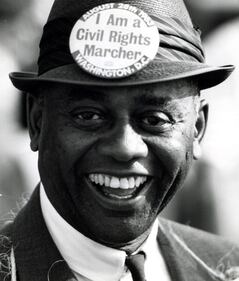
Close-up of the smiling face of an unidentified Civil Rights marcher during the March on Washington for Jobs and Freedom, Washington DC, August 28, 1963. The march and rally provided the setting for the Reverend Martin Luther King Jr's iconic 'I Have a Dream' speech. (Photo by PhotoQuest/Getty Images)
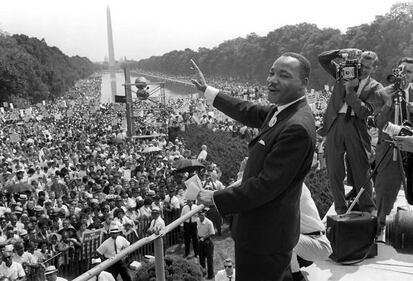
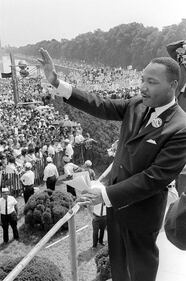
(FILES) US civil rights leader Martin Luther KIng (C) waves to supporters from the steps of the Lincoln Memorial 28 August 1963 on the Mall in Washington DC (Washington Monument in background) during the "March on Washington". 28 August marks the 40th anniversary of the famous "I Have a Dream" speech, which is credited with mobilizing supporters of desegregation and prompted the 1964 Civil Rights Act. Martin Luther King was assassinated on 04 April 1968 in Memphis, Tennessee. James Earl Ray confessed to shooting King and was sentenced to 99 years in prison. AFP PHOTO/FILES (Photo credit should read -/AFP/Getty Images)
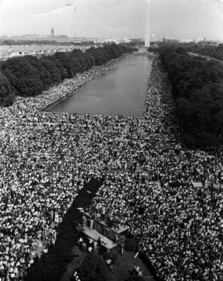
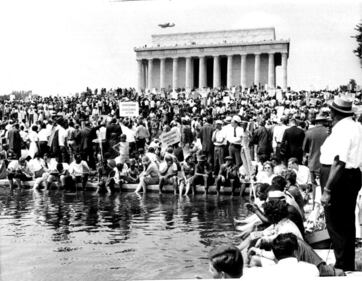
Over 200,000 people gather around the Lincoln Memorial in Washington DC, where the civil rights March on Washington ended with Martin Luther King's 'I Have A Dream' speech. (Photo by Kurt Severin/Getty Images)
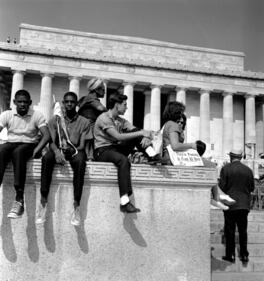
View of students as they sit on the steps of the Lincoln Memorial March on Washington for Jobs and Freedom, Washington DC, August 28, 1963. The march and rally provided the setting for the Reverend Martin Luther King Jr's iconic 'I Have a Dream' speech. (Photo by PhotoQuest/Getty Images)
American Civil Rights leader Dr. Martin Luther King Jr. (1929 - 1968) (center) delivers his iconic 'I Have a Dream' speech from the steps of the Lincoln Memorial during the March on Washington for Jobs and Freedom, Washington DC, August 28, 1963. (Photo by PhotoQuest/Getty Images)
View of American civil rights leader Martin Luther King, Jr. (1929 - 1968, center) at the March on Washington for Jobs and Freedom, where he would deliver his 'I Have a Dream' speech, Washington DC, 28th August 1963. (Photo by Rowland Scherman/Getty Images)
WASHINGTON, : US civil rights leader Martin Luther King,Jr. waves to supporters 28 August 1963 from the Lincoln Memorial on the Mall in Washington DC during the "March on Washington". On the steps of the Lincoln Memorial, King delivered his "I Have a Dream" speech, which is credited with mobilizing supporters of desegregation and prompted the 1964 Civil Rights Act. 28 August, 2003 marks the 40th anniversay of the speech. King was assassinated on 04 April 1968 in Memphis, Tennessee by James Earl Ray, who confessed to the shooting and was sentenced to 99 years in prison. AFP PHOTO/FILES (Photo credit should read AFP/AFP/Getty Images)
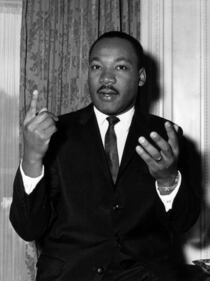
1963: American civil rights campaigner Martin Luther King Jr (1929 - 1968) at a press reception at the Ritz Hotel, London, England. (Photo by William H. Alden/Evening Standard/Getty Images)
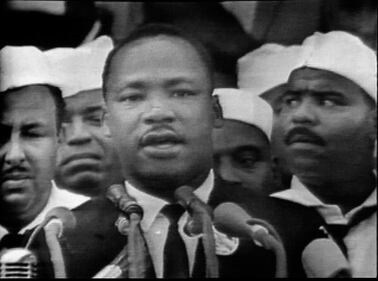
Screen capture from the CBS national broadcast of the 'I Have a Dream' speech of American civil rights leader Martin Luther King Jr. (1929 - 1968), Washington, DC, August 28, 1963. King Jr. delivered his speech on the steps of the Lincoln Memorial to over 200,000 supporters at the March on Washington for Jobs and Freedom. (Photo by CBS Photo Archive/Getty Images)
Civil Rights leaders pose in the Lincoln Memorial during the March on Washington for Jobs and Freedom, Washington DC, August 28, 1963. Pictured are, standing from left, director of the National Catholic Conference for Interracial Justice Matthew Ahmann, Rabbi Joachim Prinz (1902 - 1988), Student Nonviolent Coordinating Committee (SNCC) leader John Lewis, Protestant minister Eugene Carson Blake (1906 - 1985), Congress of Racial Equality (CORE) leader Floyd McKissick (1922 - 1991), and labor union leader Walter Reuther (1907 - 1970); sitting from left, National Urban League executive director Whitney Young (1921 - 1971), unidentified, labor union leader A Philip Randolph (1889 - 1979), Dr. Reverend Martin Luther King Jr. (1929 - 1968), and National Association for the Advancement of Colored People (NAACP) leader Roy Wilkins (1901 - 1981). The march and rally provided the setting for the Dr. King iconic 'I Have a Dream' speech. (Photo by PhotoQuest/Getty Images)
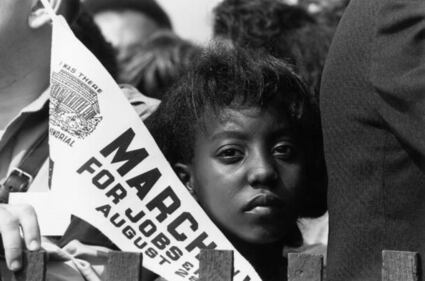
28th August 1963: A young marcher during the march for jobs and freedom to the Lincoln Memorial in Washington DC, where Martin Luther King made his famous 'I have a dream' speech. (Photo by MPI/Getty Images)
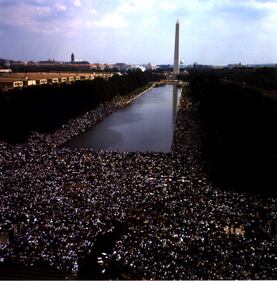
View of a portion of the crowd near the Reflecting Pool and Lincoln Memorial during the March on Washington for Jobs and Freedom, Washington DC, August 28, 1963. The march and rally provided the setting for the Reverend Martin Luther King Jr's iconic 'I Have a Dream' speech. (Photo by PhotoQuest/Getty Images)
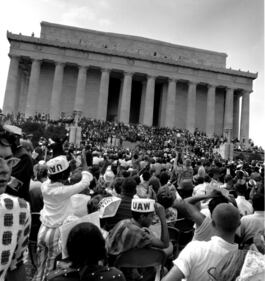
View of the crowd on the steps of the Lincoln Memorial as they listen to a speaker during the March on Washington for Jobs and Freedom, Washington DC, August 28, 1963. The march and rally provided the setting for the Reverend Martin Luther King Jr's iconic 'I Have a Dream' speech. The 'UAW' seen on several hats refers to the United Auto Workers union. (Photo by PhotoQuest/Getty Images)
Civil Rights leaders holds hands as they march along the National Mall during the March on Washington for Jobs and Freedom, Washington DC, August 28, 1963. Among those pictured in the front row are American Civil Rights leader Dr. Martin Luther King Jr. (1929 - 1968) (center), National Urban League executive director Whitney Young (1921 - 1971) (third right), National Association for the Advancement of Colored People leader Roy Wilkins (1901 - 1981) (second right), and labor union and Civil Rights leader A Philip Randolph (1889 - 1979) (right). The march and rally provided the setting for Dr. King's iconic 'I Have a Dream' speech. (Photo by PhotoQuest/Getty Images)
High-angle view of the massive crowd at the Washington Monument and Reflecting Pool during the March on Washington for Jobs and Freedom, Washington DC, August 28, 1963. The march and rally provided the setting for the Reverend Martin Luther King Jr's iconic 'I Have a Dream' speech. (Photo by PhotoQuest/Getty Images)
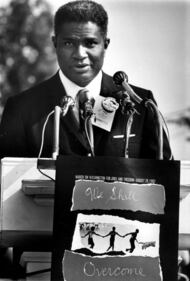
American actor and Civil Rights activist Ossie Davis (1917 - 2005) speaks before a crowd during the March on Washington for Jobs and Freedom, Washington DC, August 28, 1963. The march and rally provided the setting for the Reverend Martin Luther King Jr's iconic 'I Have a Dream' speech. The 'UAW' seen on several hats refers to the United Auto Workers union. (Photo by PhotoQuest/Getty Images)
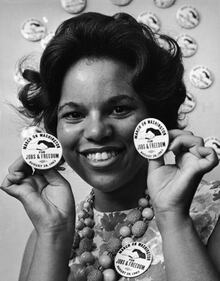
Civil rights campaigner and organizer Karen House holds up buttons for the upcoming 'March on Washington for Jobs & Freedom,' Washington, DC, August 1, 1963. During the August 28 event Dr. Martin Luther King Jr. delivered his now famous 'I have a dream' speech to a crowd of several hundred thousand. The buttons, which depcit a black hand and a white hand clasped in solidarity, were supplied by the NAACP. (Photo by Arnold Sachs/Getty Images)